
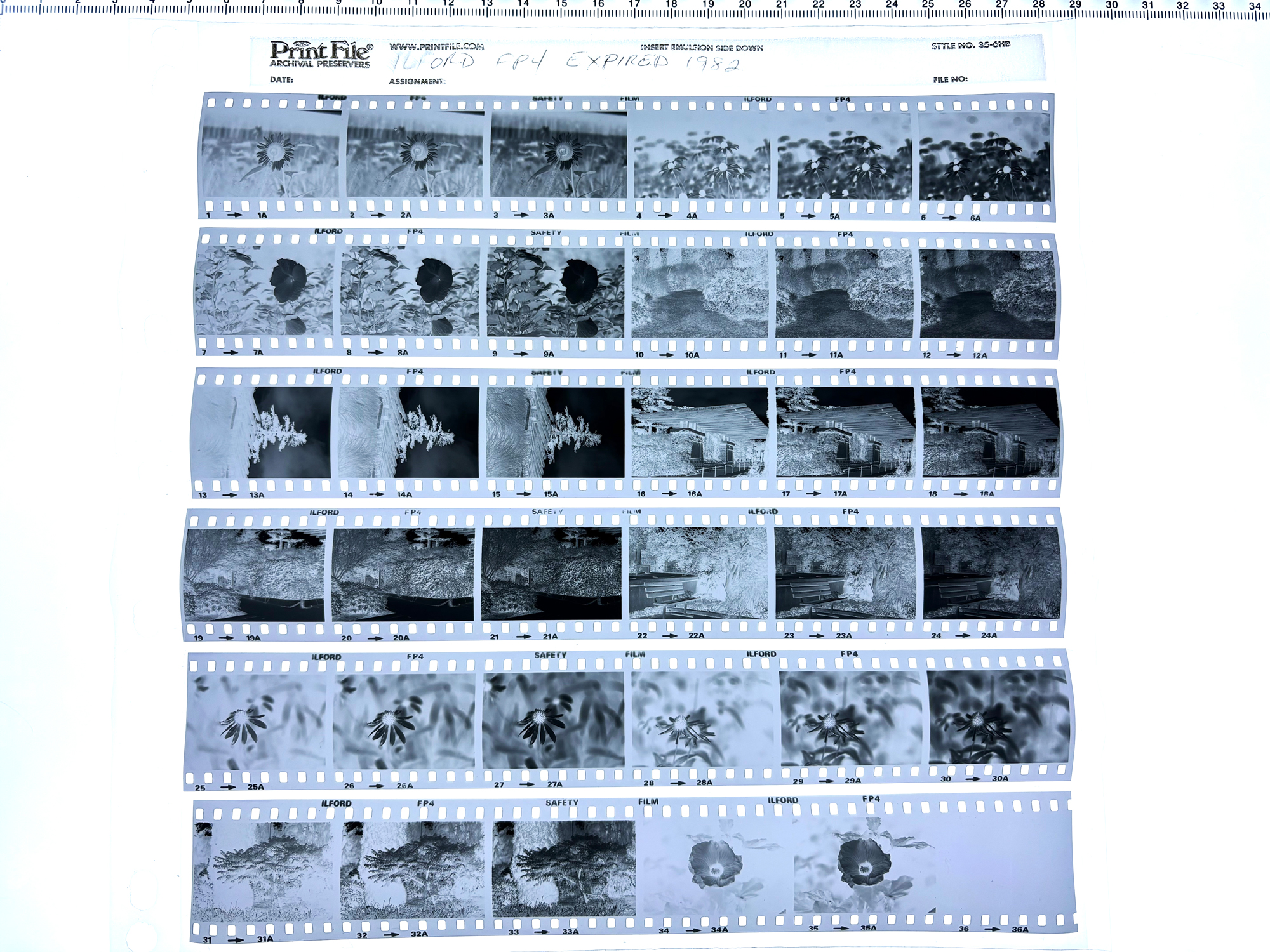
Shooting expired black-and-white film is always a bit of a darkroom gamble, but working with an emulsion that predates the fall of the Berlin Wall and was produced when big hair and Aqua-Net were the rage, pushes that experiment to its absolute limit. I recently acquired a roll of original Ilford FP4—the legendary predecessor to modern FP4 Plus—stamped with an expiration date of September 1982.
Forty-four years is a long time for silver halide crystals to sit on a shelf. Over four decades, ambient background radiation and thermal energy break down the emulsion, causing two distinct issues: a significant loss of effective film speed and a heavy, dark layer of base fog that eats away at contrast. I also have no idea how this film was stored.
Rather than running the film through a casual point-and-shoot, I treated this roll as a controlled darkroom experiment to see how much image quality could be reclaimed using precision hardware, deliberate exposure bracketing, and custom anti-fog chemistry.
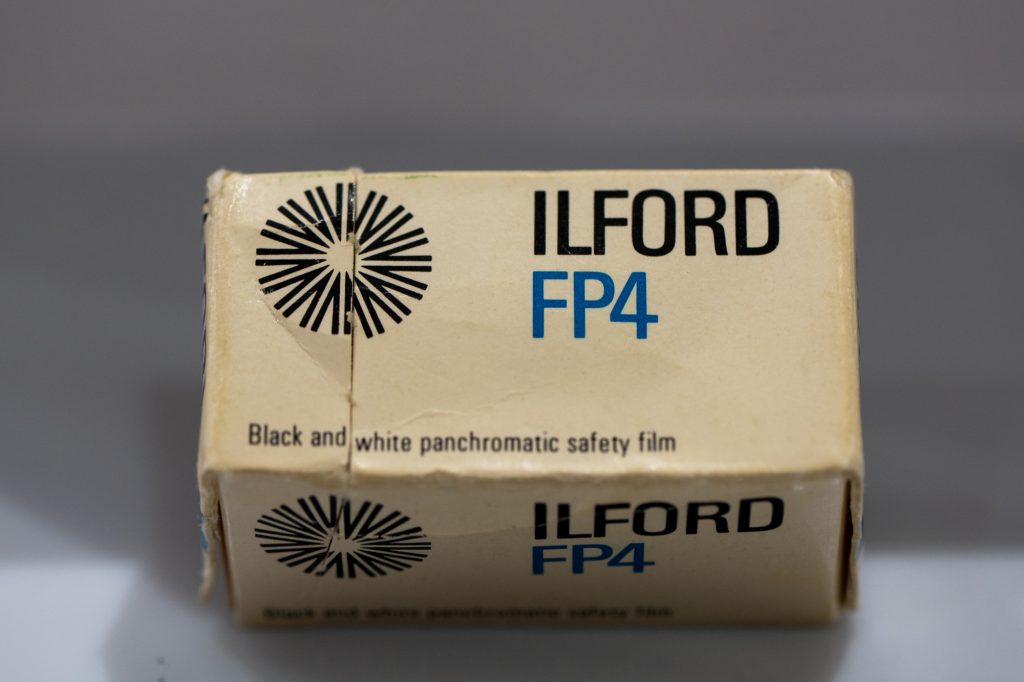
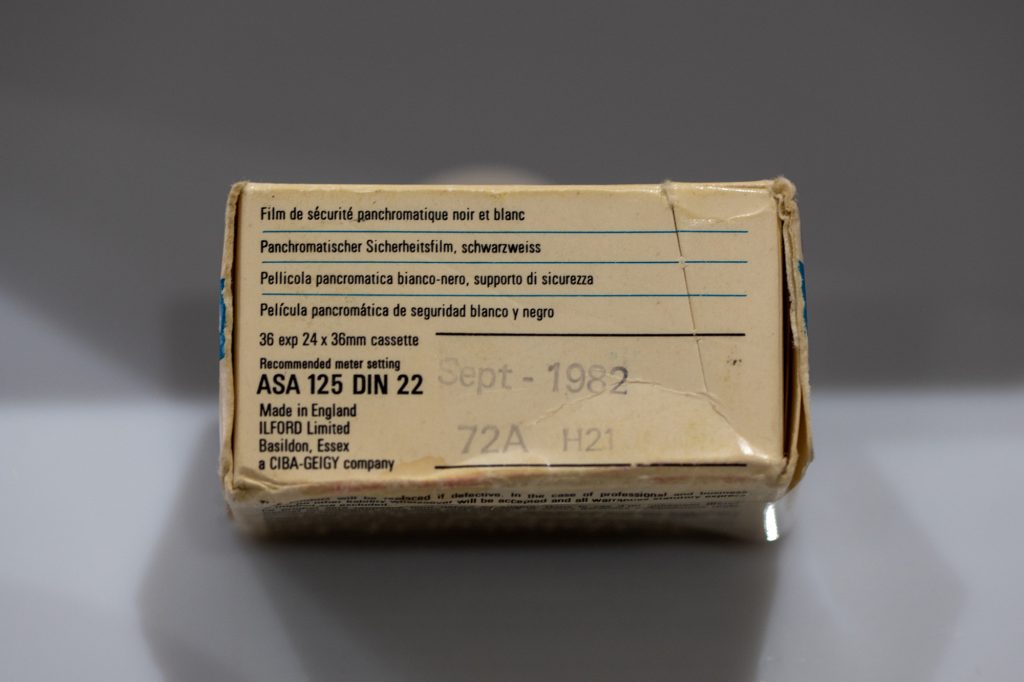
The Gear Setup: High-Contrast Optics Meets Vintage Emulsion
To eliminate hardware-induced flare and metering errors from the equation, I loaded the 1982 roll into my Nikon F6.
Using a modern 35mm SLR flagship for a 40-year-old roll might seem like overkill, but it provided two vital technical advantages:
- Flawless Exposure Metering: The 3D Color Matrix Metering on the F6 guaranteed that my baseline test frames were benchmarked with complete consistency.
- 1/8000s Shutter Speed: Overexposing expired film requires opening up apertures or dropping shutter speeds. When shooting fast glass wide-open in bright daylight at lower effective ISOs, the F6’s 1/8000s top shutter allowed me to shoot without needing neutral density (ND) filters.
For glass, I picked two ultra-sharp, high-contrast primes: the Sigma 50mm f/1.4 and the Nikkor 85mm f/1.4G AF ED. Modern multi-coatings and high edge-to-edge resolving power are essential when trying to punch clear subject detail through the flat, muddy contrast layer of an aged emulsion.
The Exposure Strategy: Putting the “1-Stop Per Decade” Rule to the Test
The anecdotal rule of thumb for expired film is to overexpose by 1 stop per decade past expiration. For a medium-speed film like original FP4 (box speed ISO 125) sitting idle for over 4 decades, that math suggests shooting somewhere around ISO 8 to ISO 12.
To find the actual sweet spot, I configured the Nikon F6 for a 3-frame auto-bracketing series with a +1 EV exposure compensation baseline:
- Frame 1 (Normal): ISO 125 (0 EV Compensation)
- Frame 2 (+1 Stop): ISO 64 (+1 EV Overexposure)
- Frame 3 (+2 Stops): ISO 32 (+2 EV Overexposure)
By bracketing every scene, I wanted to see whether the film retained enough usable sensitivity at box speed or if +2 stops was enough and required to push shadow detail above the fog floor.
Darkroom Workflow: Fighting Base Fog with Benzotriazole & HC-110
Developing really old film requires a fine balance: you need enough developer action to build highlight density, but prolonged processing increases background chemical fog. High-dilution stand development (like Rodinal 1:100) is notoriously bad for expired film because it allows fog to build unchecked across the entire strip.
My developer of choice was Kodak HC-110 at Dilution H (1+63). HC-110 contains organic restrainers that naturally keep fog lower than solvent-heavy developers like D-76. Using Dilution H provides a gentle, controlled development curve that protects highlights on overexposed frames while allowing plenty of time to work.
To further hold back the fog layer, I added Benzotriazole (Anti-Fog #1) directly to the working bath.
The Two-Stage Chemistry Recipe (For a 300 mL Single-Reel Tank):
- Mixing the 1% Stock Solution: First, I dissolved 1.0 gram of dry Benzotriazole powder into warm distilled water to make a 100 mL stock solution (a 1% w/v concentration).
- Mixing the Tank:
- 290 mL Distilled Water at 20°C (68°F)
- 4.5 mL 1% Benzotriazole Stock Solution (dosed at 15 mL per Liter of total developer)
- 4.7 mL Kodak HC-110 Concentrate Syrup (giving a 1+63 Dilution H ratio)
In the final working solution, the Benzotriazole sat at a concentration of 0.015% (0.15 g/L). Because Benzotriazole acts as a speed restrainer, I extended the standard Dilution H development time by approximately +15%, running the tank for 14 minutes at 20°C (68°F) with slow, gentle inversions every 60 seconds.
Results & Contact Sheet Analysis
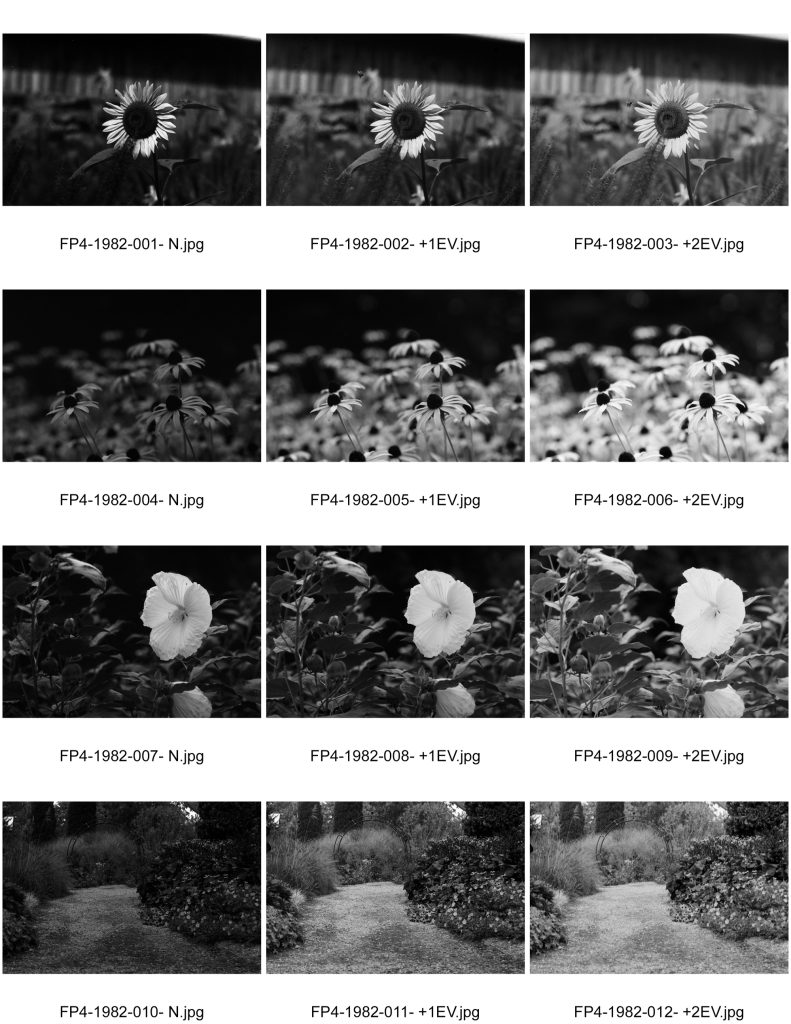
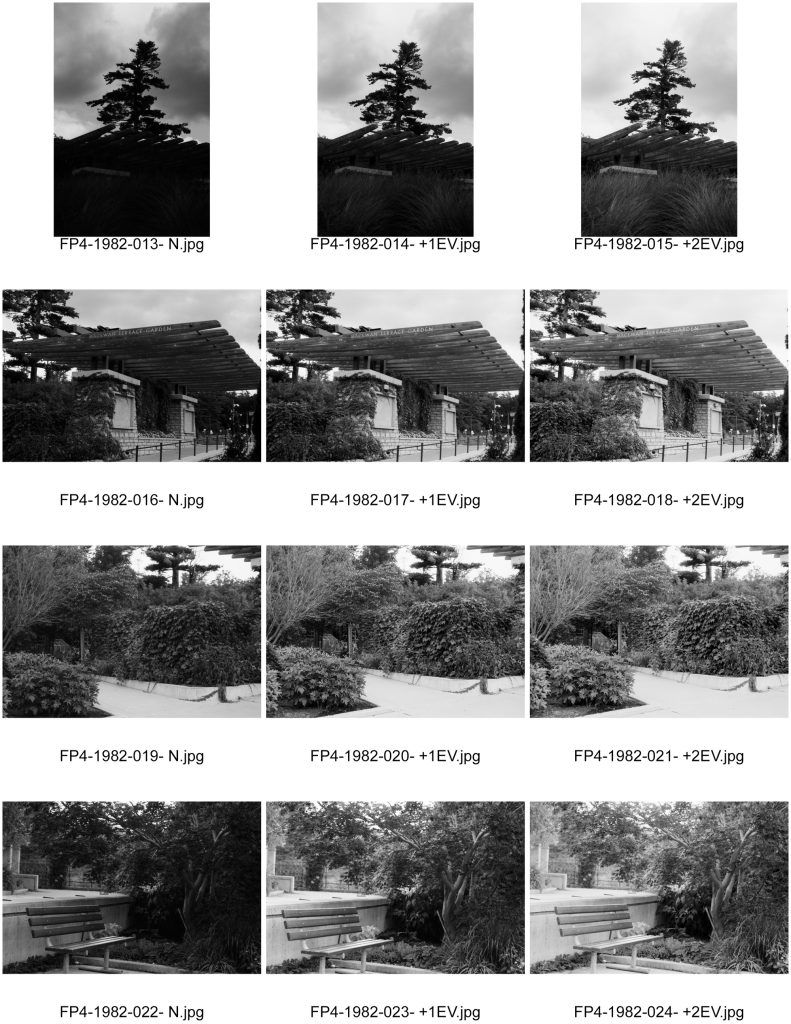
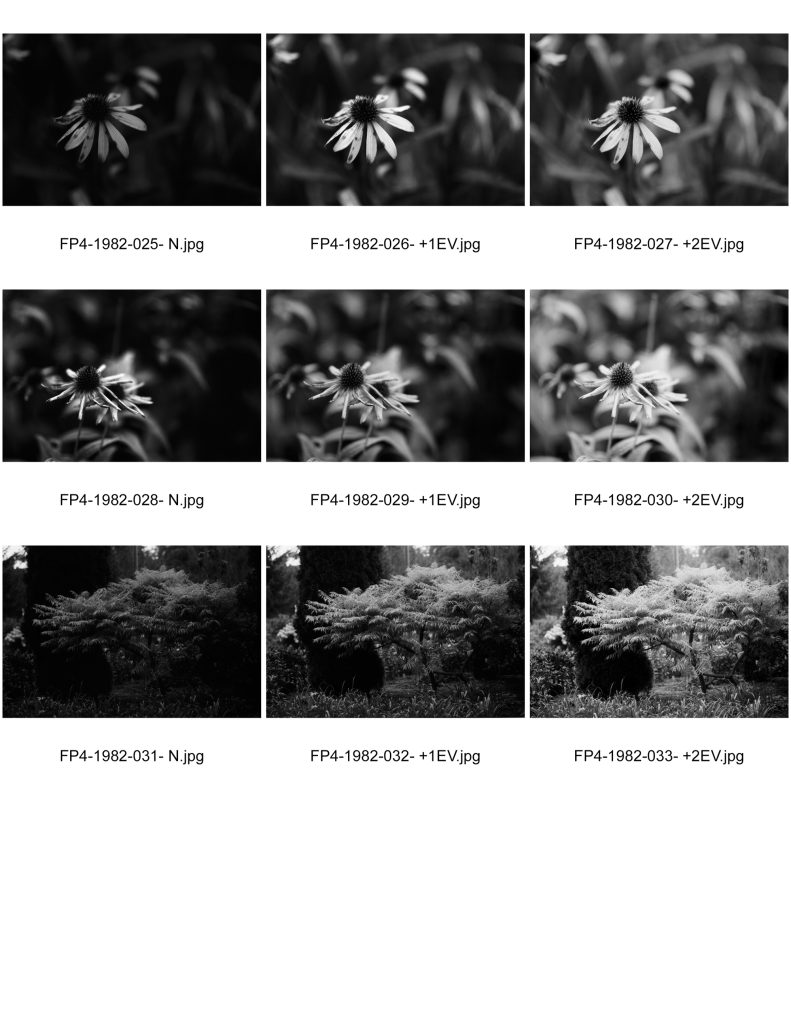
The density difference across the bracketed frames was striking on the light table.
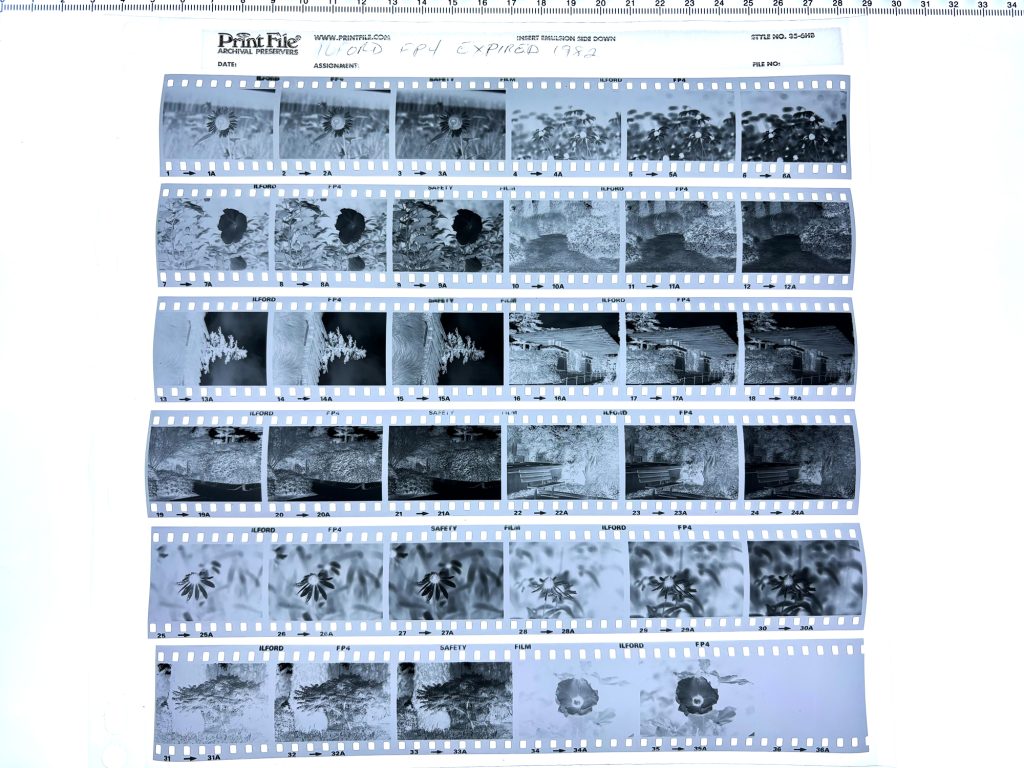
Evaluating the contact sheet confirms that the Benzotriazole did its job:
- Clean Rebates & Frame Borders: The clear film margins between frames and around the sprockets retained excellent base transparency rather than developing into a cloudy grey haze.
- Frame Separation: The image areas maintain distinct highlight punch and separation, proving the restrainer held back chemical fog across the entire 14-minute development bath.
Comparing the Exposure Bracket
Looking at a three-frame test sequence of a park structure and tree against a cloudy sky shows exactly how the emulsion behaved:
| Shot | Effective ISO | Visual Result |
|---|---|---|
Frame 1 (FP4-1982-013- N.jpg) | ISO 125 | Severely Underexposed: Shadow detail in the foreground grass and wooden trellis structure is completely crushed into black silhouette. |
Frame 2 (FP4-1982-014- +1EV.jpg) | ISO 64 | Marginal: Wood textures start to appear, but shadow areas remain largely blocked up. |
Frame 3 (FP4-1982-015- +2EV.jpg) | ISO 32 | Correctly Exposed: Overexposing by +2 stops pushed shadow detail safely above the fog floor. |
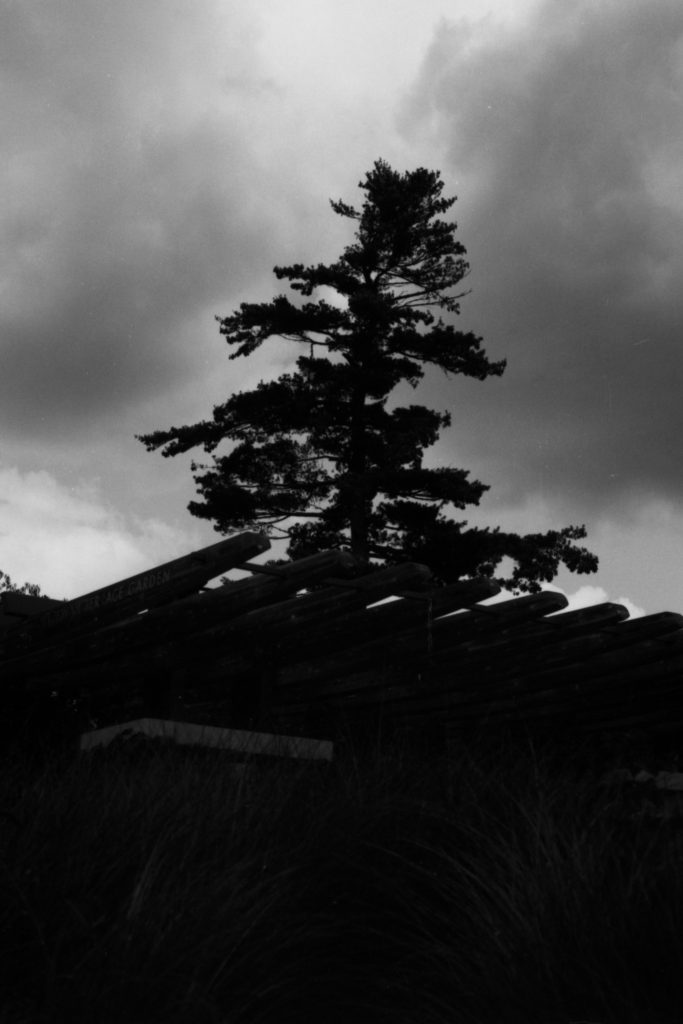
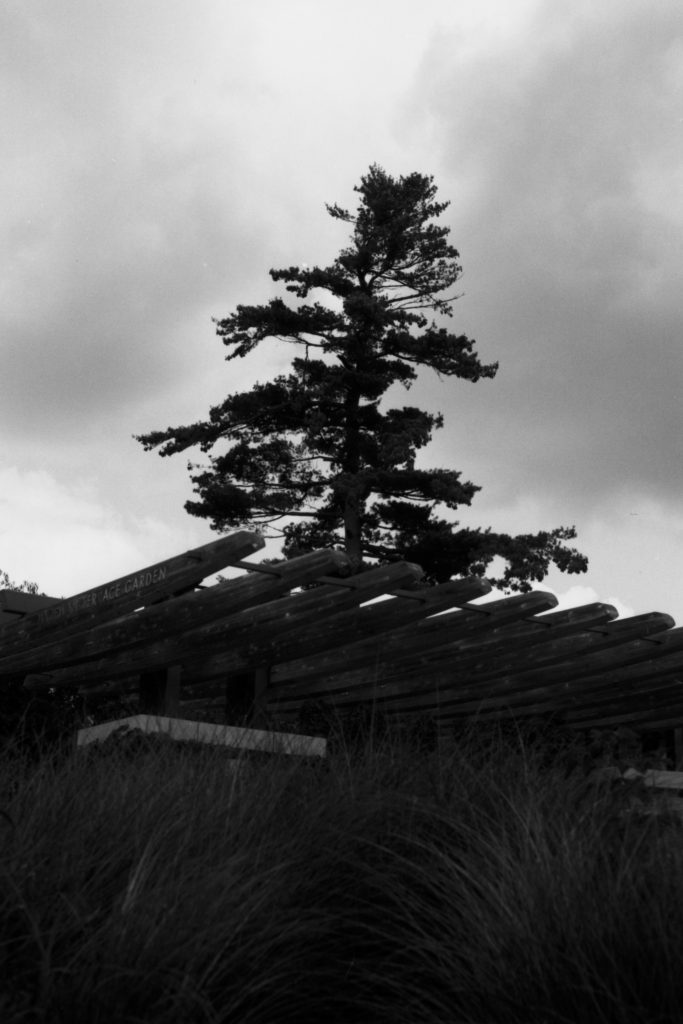
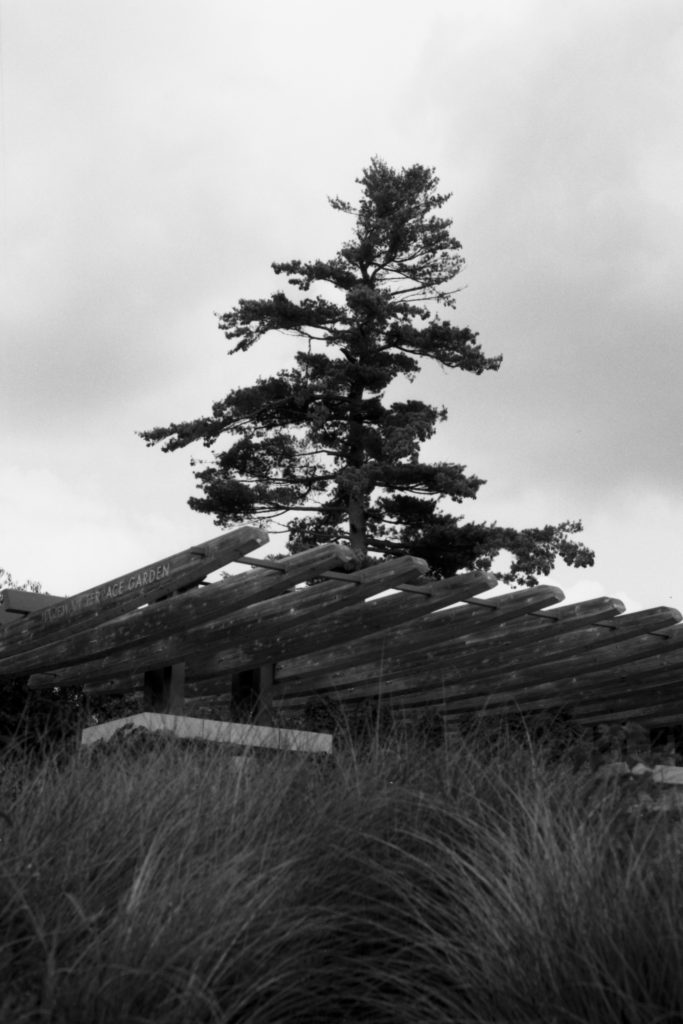
In the +2 EV (ISO 32) shot, the carved lettering “WETLAND HERITAGE GARDEN” on the wooden beam becomes clearly readable, individual grass blades in the foreground reveal texture, and pine foliage retains fine detail without blowing out the cloud structure in the sky.



Key Takeaways for Expired Film Shooters
- Emulsion Speed Loss is Real: A 44-year-old roll of FP4 essentially behaves like an ISO 32 film. Plan to give old black-and-white stock at least +2 stops of overexposure. JPG+ 1
- Benzotriazole Works: Adding a 1% Benzotriazole stock solution at 15 mL/L kept the film base clean and transparent, making scanning and black-point adjustments in post-processing straightforward. JPG
- HC-110 Dilution H is Ideal: The combination of HC-110’s built-in restrainers and Dilution H’s extended timing gave smooth midtones and protected highlights from blocking up on overexposed frames.
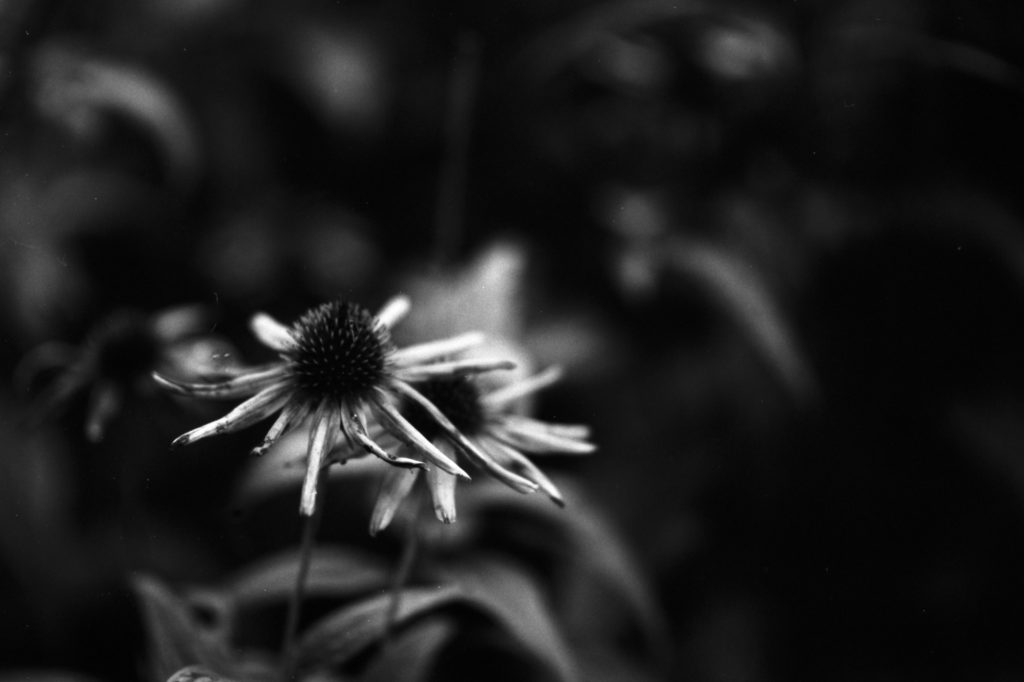


Based on the results from this test roll, this experiment somewhat supports the “1 stop per decade” rule of thumb as a solid baseline, but highlights important nuances.
Here is how the data breaks down:
1. The Math vs. Reality
- The Rule: FP4 has a box speed of ISO 125. At ~4.4 decades past its 1982 expiration date, the 1-stop-per-decade rule suggests adding +4.4 stops of light—targeting an effective film speed of ISO 6 to ISO 8.
- The Result: The bracketed frames showed that +2 stops (ISO 32) yielded a fully usable image with good shadow detail (such as the carved lettering on the wooden beam and texture in the grass) and clear highlight separation.
2. Why +2 Stops (ISO 32) Was Enough Instead of +4 Stops
While +4 stops would theoretically match the formula strictly, two key factors made ISO 32 (+2 stops) perform so well:
- Medium-Speed Black & White Holds Up Better: The 1-stop-per-decade rule is a broad, catch-all safety net designed to cover unpredictable storage conditions and high-speed or color emulsions (which degrade much faster due to background radiation and dye shifting). Slow-to-medium speed black-and-white films (ISO 50–125) age much more gracefully than ISO 400+ films or color negative stocks.
- Chemical Restrainers Recover Effective Speed: By adding Benzotriazole to the HC-110 Dilution H developer, chemical base fog was actively suppressed. High base fog acts like “noise” that buries shadow detail; suppressing that fog floor allows usable shadow information to emerge at a higher effective ISO (ISO 32) than if the film were developed normally or stand-developed without a restrainer.
Summary
The experiment proves that overexposure is strictly required for four-decade-old film (as box speed at ISO 125 was severely underexposed and unusable). However, it demonstrates that for well-stored medium-speed B&W film paired with anti-fog chemistry, you often need less overexposure (+2 stops) than the full decade formula predicts (+4 stops).
Stay Tuned for More!
Also, make sure to stay tuned for an upcoming episode of the Classic Camera Revival Podcast, where my co-hosts and I will be discussing this 1982 FP4 test roll in detail, sharing physical negatives, and breaking down all things expired film chemistry!