

There is something undeniably magical about stepping into a real brick-and-mortar camera shop, chatting with familiar faces, and walking out with a piece of gear that immediately sparks your creative drive. As a retired professional photographer who now shoots purely for the joy of the craft, those moments are what keep film photography so deeply rewarding.
On a recent visit to one of my absolute favorite local spots, Burlington Camera, Joan was as helpful as always. She consistently manages to lighten my pocketbook by offering fair prices on rare, interesting finds. This time, I couldn’t resist picking up a Horizon 202 in very good condition—and at an always reasonable price.
What is the Horizon 202?
For those unfamiliar, the Horizon 202 is a Russian-made 35mm panoramic camera manufactured by KMZ. Unlike cropped panoramic cameras that simply mask the top and bottom of a standard 24x36mm frame, or wide-angle prime lenses that introduce heavy barrel distortion, the Horizon 202 is a true swing-lens panoramic camera.
When you trip the shutter, the 28mm f/2.8 lens swings through an arc inside a rotating drum, sweeping a narrow slit of light across a curved film plane. The result is a massive 24x58mm exposure on standard 35mm film—giving you an ultra-wide 120° horizontal field of view without bending straight lines across the center of your horizon.

The Learning Curve: Loading & Quirky Ergonomics
Even with decades of professional experience under my belt, new film cameras can still throw a curveball! The Horizon 202 has a notoriously unique film path: the leader must feed underneath the sprockets, around the curved film gate, and onto the take-up spool in a very specific way to prevent jam-ups or uneven spacing.
Sure enough, I managed to load my very first roll incorrectly. After a quick trip over to YouTube for a tutorial refresh, I got the mechanism sorted out. It’s all part of the charm of working with vintage mechanical equipment—every camera has its own rhythm you have to learn.
Once loaded, handling the camera requires a whole new set of physical habits:
- Watching the Drum: The Horizon 202 is definitely quirky. Because the lens drum rotates through a wide outer arc on the front panel, you have to watch your fingers and thumbs closely. Any misplaced fingertips on the body will happily block the drum and make an unwelcome appearance in your frame.
- Mastering the Level: Swing-lens cameras exaggerate any tilt. If you point the camera up or down even slightly, straight horizons instantly turn into wildly curved, distorted perspectives. It takes deliberate concentration and careful reliance on the built-in top-plate bubble level (visible through the viewfinder) to keep the camera completely plumb before tripping the shutter.
- Shutter & Exposure Control: Setting exposure relies on a two-speed drum motor combined with variable slit widths to achieve speeds ranging from 1/2s to 1/250s.
Field Test: Locke Street, Hamilton
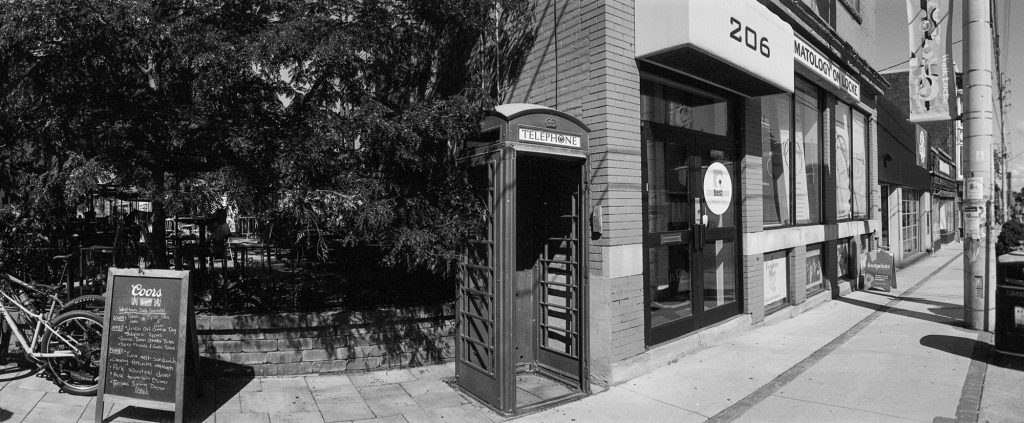
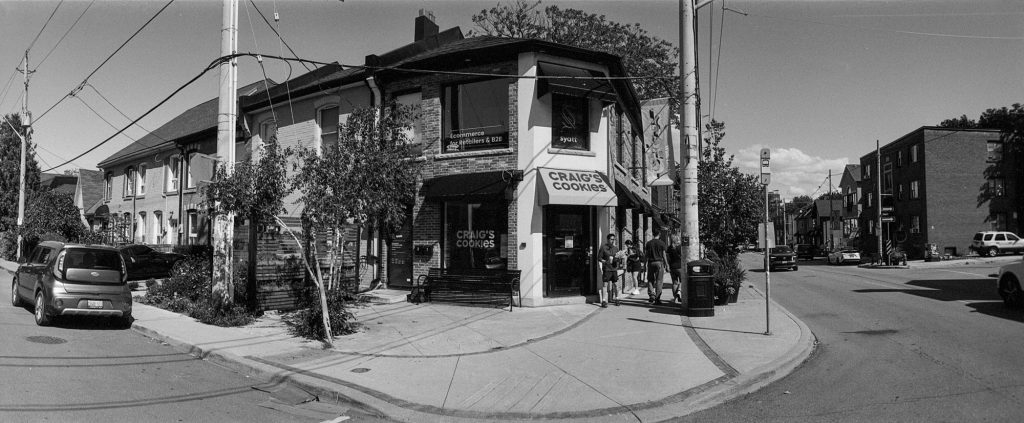
To put the new setup through its paces, I loaded a roll of Lomography Potsdam 100 and took a stroll down Locke Street in Hamilton. The mix of historic storefronts, outdoor cafes, and lively street scenes makes it a fantastic testing ground for sweeping, ultra-wide compositions.
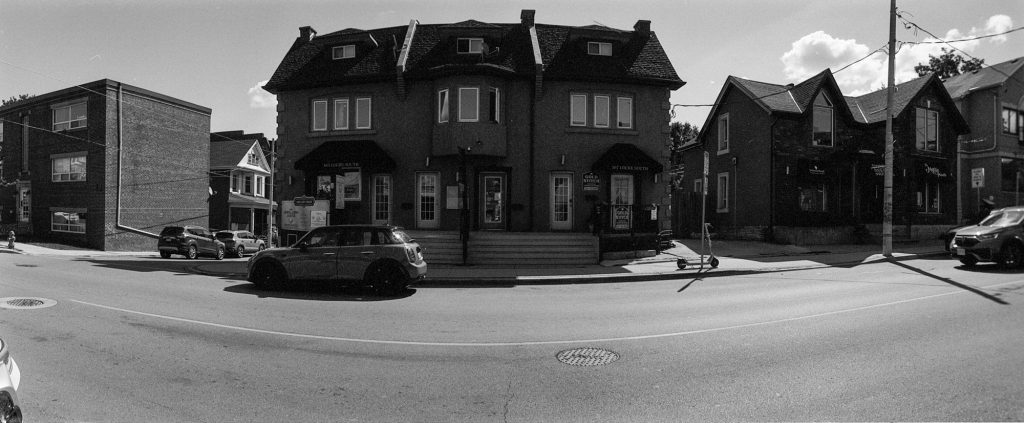
Since I didn’t have a handheld meter with me on this outing, I opted for the tried and trusted Sunny 16 rule. Given the bright direct daylight, all of these images were shot consistently at f/16 at 1/125s.
Shooting a 120° field of view forces you to re-train your eye. Standard rule-of-thirds compositions give way to sweeping leading lines, expansive architecture, and dramatic environmental scenes. You have to consider not just your main subject, but everything happening on the far left and right edges of your vision.

The Good, The Bad, and The Awesome
| The Good | The Bad | The Awesome |
|---|---|---|
| Great edge-to-edge optical sharpness across the full 58mm length. In-viewfinder bubble level makes keeping horizons flat much easier. Completely mechanical operation—no batteries required. | Fiddly film loading path that takes practice (and YouTube) to master. Quirky ergonomics require careful finger placement so thumbs don’t block the drum. Very sensitive to tilt distortion if you stray from level. | True 120° swing-lens panoramic look on standard 35mm film without prime distortion. Whirring mechanical drum sound during exposure is immensely satisfying. Pure, fun creative exercise that forces you to completely rethink composition. |
Darkroom Workflow
Back in the darkroom, I processed the roll in CineStill D96 developer for 6 minutes at 20°C. The silver-rich emulsion of Potsdam 100 paired with D96 delivers rich tonal transitions, fine grain, and crisp detail that really lets those panoramic negatives pop.

Final Thoughts
Talking about gear on the Classic Camera Revival Podcast is one thing, but getting out into the field and seeing how a camera changes your composition is where the real fun lies. The Horizon 202 is quirky, completely mechanical, and keeps you on your toes—which is exactly why I love shooting film. Big thanks to Joan at Burlington Camera for another great find.